What's New in Mnemonics?
Written on January 19th, 2026 by Tech Ads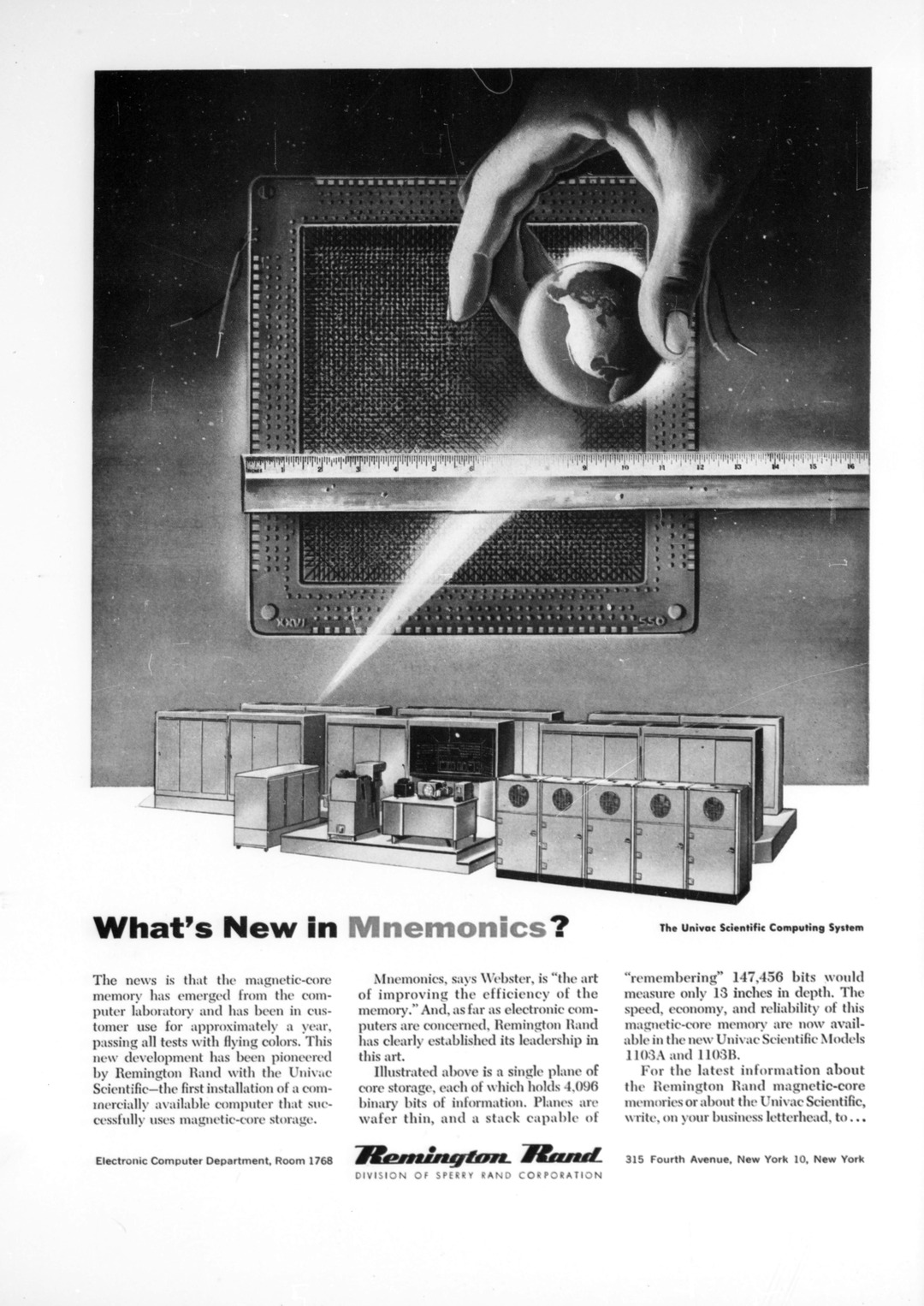
[expand]
Page 1
; . < ak

SRS SRR ERE RE ER SS

+ ~?

" a2 Us S

POLL UV UD WUD MUU UUM UU UL Nou mar OTD UD ULL
” vice ; <a

> > > e + . _ . : >: : . > —

rTrTFeaePrFeeeeteereerePrteerees SF

What’s New in Vinemonics?

The news is that the magnetic-core
memory has emerged from the com-
puter laboratory and has been in cus-
tomer use for approximately a vear,
passing all tests with flying colors. This
new development has been pioneered
by Remington Rand with the Univac
Scientific—the first installation of a com-
mercially available computer that suc-
cessfully uses magnetic-core storage.

Electronic Computer Department, Room 1768

Mnemonics, says Webster, is “the art
of improving the efficiency of the
memory.” And, as far as electronic com-
puters are concerned, Remington Rand
has clearly established its leadership in
this art.

Illustrated above is a single plane of
core storage, each of which holds 4,096
binary bits of information. Planes are

wafer thin, and a stack capable of

Flemington. Fkand

DIVISION OF SPERRY RAND CORPORATION

BRR RDO AAR RRNA

The Univac Scientific Computing System

“remembering” 147,456 bits would
measure only 13 inches in depth. The
speed, economy, and reliability of this
magnetic-core memory are now avail-
able in the new Univac Scientific Models
LIOSA and L1LO3B.

For the latest information about
the Remington Rand magnetic-core
memories or about the Univac Scientific,
write, on your business letterhead, to...

315 Fourth Avenue, New York 10, New York
[/expand]
‘What’s New in Mnemonics?’
One of my favourite ads featured so far - if, for nothing else, the accompanying illustration of the Univac Scientific Computing System.
Core memory was an early form of RAM and comprised of a large number of magnetic rings woven into a matrix of copper wires. Core memory was the predominant form of memory used in computers between 1955 and the mid 1970s at which time semiconductor-based memory replaced Core in almost all circumstances.
The Univac Scientific Model 1103A was a US-focused vacuum-tube based computer design that weighed in at around 17.5 tons.
This US navy training video contains a short primer on Core Memory from around ten minutes, twelve seconds onwards.
Taken from: Datamation - Volume 1, Issue 1 (July - August 1955)