Micro's too small
Written on June 2nd , 2026 by Tech Ads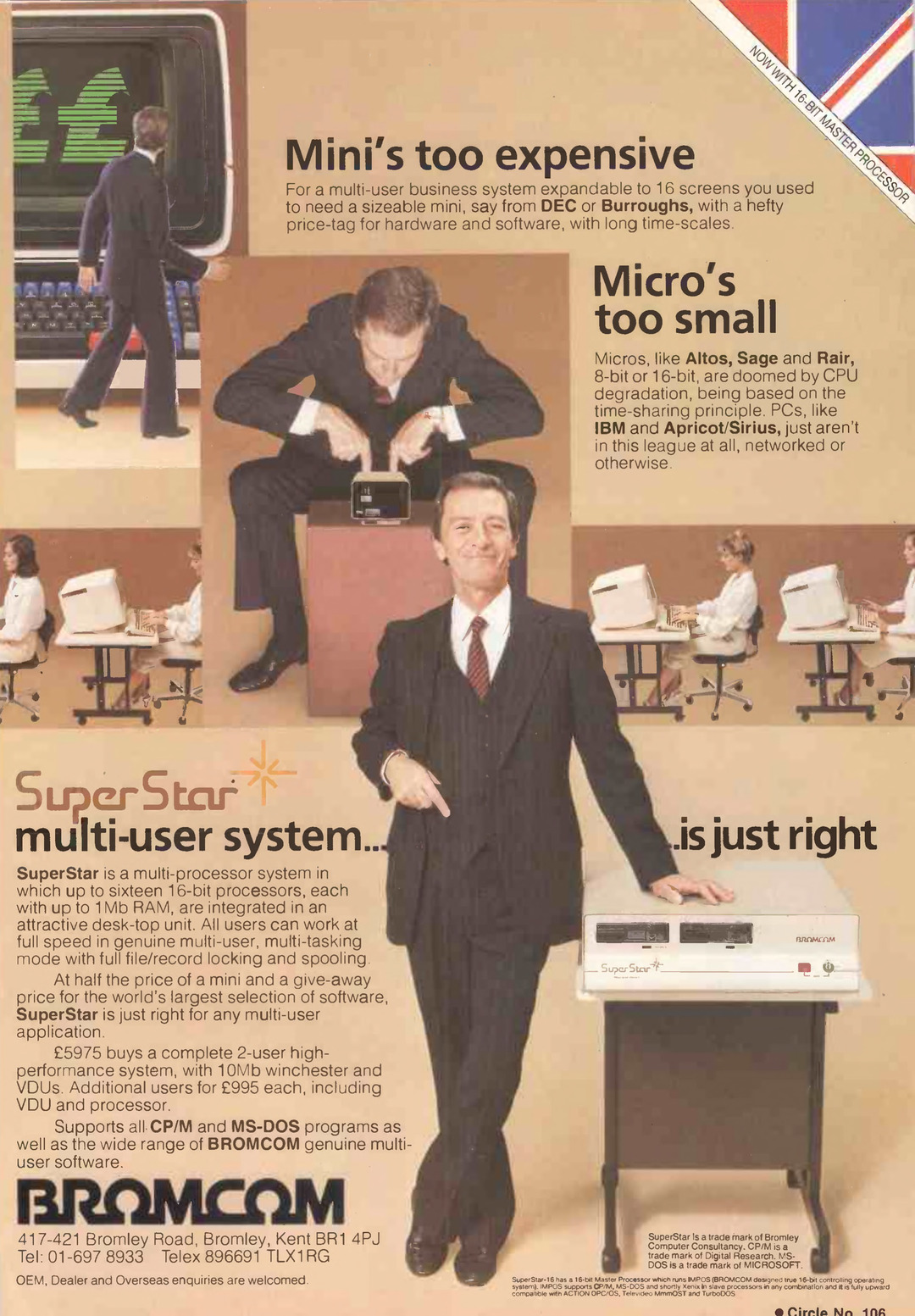
[expand]
Page 1
Mini's too expensive

For a multi-user business system expandable to 16 screens you used
to need a sizeable mini, say from DEC or Burroughs, with a hefty
price-tag for hardware and software, with long time-scales

Micro's
too small

Micros, like Altos, Sage and Rair,
8-bit or 16-bit, are doomed by CPU
degradation, being based on the
time-sharing principle. PCs, like
IBM and Apricot/Sirius, just aren't
in this league at all, networked or
otherwise.

e
ame =

multi-user system is just right
SuperStar is a multi-processor system in
which up to sixteen 16-bit processors, each
with up to 1Mb RAM, are integrated in an
attractive desk-top unit. All users can work at
full soeed in genuine multi-user, multi-tasking
mode with full file/record locking and spooling

At half the price of a mini and a give-away
price for the world's largest selection of software,
SuperStar is just right for any multi-user
application.

£5975 buys a complete 2-user high-
performance system, with 10Mb winchester and
VDUs. Additional users for £995 each, including
VDU and processor.

Supports all.CP/M and MS-DOS programs as
well as the wide range of BROMCOM genuine multi-
user software.

417-421 Bromley Road, Bromley, Kent BR1 4PJ
Tel: 01-697 8933 Telex 896691 TLX1RG

OEM, Dealer and Overseas enquiries are welcomed.

RRAMCOM

SuperStar Is a trade mark of Bromley

Computer Consultancy. CP/M is a
trade mark of Digital Research. MS-
DOS is a trade mark of MICROSOFT.

SuperStar-16 has a 16-bit Master Processor which runs IMPOS (BROMCOM designed true 16-bit controlling operating
system). IMPOS supports GP/M, MS-DOS and shortly Xenix in slava processors in any combination and itis fully upward
compatible with ACTION OPC/OS, Televideo MmmOST and TurboDOS:

@Cirerlea Na ine
[/expand]
‘Micro’s too small’
The Bromcom SuperStar was a 16bit multi-user microcomputer designed for back office digitisation at a price-point lower than a minicomputer.
A positive review of the Bromcom Superstar can be found in the April 16, 1984 issue of the Financial Times.
Feel free to share!