Apple Introduces...
Written on April 1st , 2026 by Tech Ads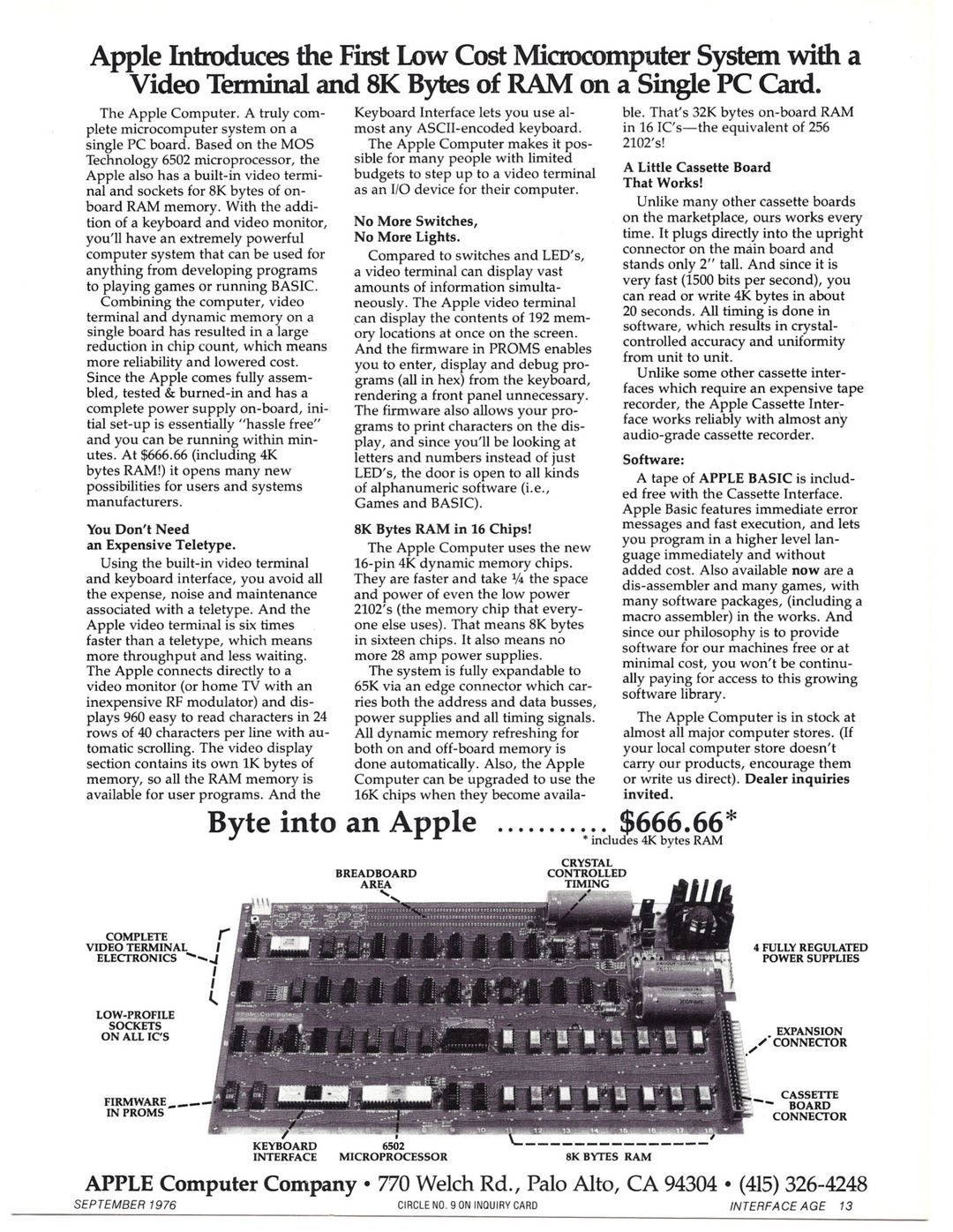
[expand]
Page 1
Apple Introduces the First Low Cost Microcomputer System with a
Video Terminal and 8K Bytes of RAM on a Single PC Card.

The Apple Computer. A truly com-
plete microcomputer system on a
single PC board. Based on the MOS
Technology 6502 microprocessor, the
Apple also has a built-in video termi-
nal and sockets for 8K bytes of on-
board RAM memory. With the addi-
tion of a keyboard and video monitor,
you'll have an extremely powerful
computer system that can be used for
anything from developing programs
to playing games or running BASIC.

Combining the computer, video
terminal and dynamic memory on a
single board has resulted in a large
reduction in chip count, which means
more reliability and lowered cost.
Since the Apple comes fully assem-
bled, tested & burned-in and has a
complete power supply on-board, ini-
tial set-up is essentially ‘‘hassle free”
and you can be running within min-
utes. At $666.66 (including 4K
bytes RAM!) it opens many new
possibilities for users and systems
manufacturers.

You Don’t Need
an Expensive Teletype.

Using the built-in video terminal
and keyboard interface, you avoid all
the expense, noise and maintenance
associated with a teletype. And the
Apple video terminal is six times
faster than a teletype, which means
more throughput and less waiting.
The Apple connects directly to a
video monitor (or home TV with an
inexpensive RF modulator) and dis-
plays 960 easy to read characters in 24
rows of 40 characters per line with au-
tomatic scrolling. The video display
section contains its own 1K bytes of
memory, so all the RAM memory is
available for user programs. And the

Byte into an Apple

COMPLETE
VIDEO TERMINAL
ELECTRONICS ~~

LOW-PROFILE
SOCKETS
ON ALL IC’S
FIRMWARE _ _. — —s
IN PROMS Seen ra
KEYBOARD
INTERFACE

6502
MICROPROCESSOR

Keyboard Interface lets you use al-
most any ASCII-encoded keyboard.
The Apple Computer makes it pos-
sible for many people with limited
budgets to step up to a video terminal
as an I/O device for their computer.

No More Switches,
No More Lights.

Compared to switches and LED’s,
a video terminal can display vast
amounts of information simulta-
neously. The Apple video terminal

can display the contents of 192 mem-

ory locations at once on the screen.
And the firmware in PROMS enables
you to enter, display and debug pro-
grams (all in hex) from the keyboard,
rendering a front panel unnecessary.
The firmware also allows your pro-
grams to print characters on the dis-
play, and since you'll be looking at
letters and numbers instead of just
LED’s, the door is open to all kinds
of alphanumeric software (i.e.,
Games and BASIC).

8K Bytes RAM in 16 Chips!

The Apple Computer uses the new
16-pin 4K dynamic memory chips.
They are faster and take 4 the space
and power of even the low power
2102’s (the memory chip that every-
one else uses). That means 8K bytes
in sixteen chips. It also means no
more 28 amp power supplies.

The system is fully expandable to
65K via an edge connector which car-
ries both the address and data busses,
power supplies and all timing signals.
All dynamic memory refreshing for
both on and off-board memory is
done automatically. Also, the Apple
Computer can be upgraded to use the
16K chips when they become availa-

y: reqnecosceete SSecstI9ssRsaes7GNs5¢

chitepeyae SOSeaeersyse3oa3s593

245° eet ee ek en

tesa

Po)
ee?
~

ble. That’s 32K bytes on-board RAM
in 16 IC’s—the equivalent of 256
2102's!

A Little Cassette Board
That Works!

Unlike many other cassette boards
on the marketplace, ours works every
time. It plugs directly into the upright
connector on the main board and
stands only 2” tall. And since it is
very fast (1500 bits per second), you
can read or write 4K bytes in about
20 seconds. All timing is done in
software, which results in crystal-
controlled accuracy and uniformity
from unit to unit.

Unlike some other cassette inter-
faces which require an expensive tape
recorder, the Apple Cassette Inter-
face works reliably with almost any
audio-grade cassette recorder.

Software:

A tape of APPLE BASIC is includ-
ed free with the Cassette Interface.
Apple Basic features immediate error
messages and fast execution, and lets
you program in a higher level lan-
guage immediately and without
added cost. Also available now are a
dis-assembler and many games, with
many software packages, (including a
macro assembler) in the works. And
since our philosophy is to provide
software for our machines free or at
minimal cost, you won’t be continu-
ally paying for access to this growing
software library.

The Apple Computer is in stock at
almost all major computer stores. (If
your local computer store doesn’t
carry our products, encourage them
or write us direct). Dealer inquiries
invited.

seseseeeess $666.66%

* includes 4K bytes RAM
CRYSTAL
BREADBOARD CONTROLLED
AREA TIMING

4 FULLY REGULATED
POWER SUPPLIES

% EXPANSION

&_ ‘CASSETTE
‘~~ BOARD
CONNECTOR

APPLE Computer Company « 770 Welch Rd., Palo Alto, CA 94304 « (415) 326-4248

SEPTEMBER 1976

CIRCLE NO. 9 ON INQUIRY CARD

INTERFACE AGE 13
[/expand]
‘Apple Introduces…’
And now something for the 50th anniversary of Apple’s founding - an early advert for Apple’s first product; the board that was then known as the ‘Apple Computer’ and is now better known as the ‘Apple I’. Based around a MOS 6502 processor running at 1Mhz and 4 KB of RAM (expandable to 8KB on board and up to 64Kb via an add-in card!), the Apple 1 was sold as a soldered board complete with all components and firmware with the user expected to provide keyboard, display, tape storage and case. Production of the Apple 1 was discontinued in September 1977, a mere 15 months after its formal launch.
In 2024 an Apple 1 from the Paul G. Allen Collection sold at Christie’s for 352,800USD.
A copy of the Apple 1 Operation Manual can be viewed at AppleFritter.