Newton to Nemo...
Written on January 29th, 2026 by Tech Ads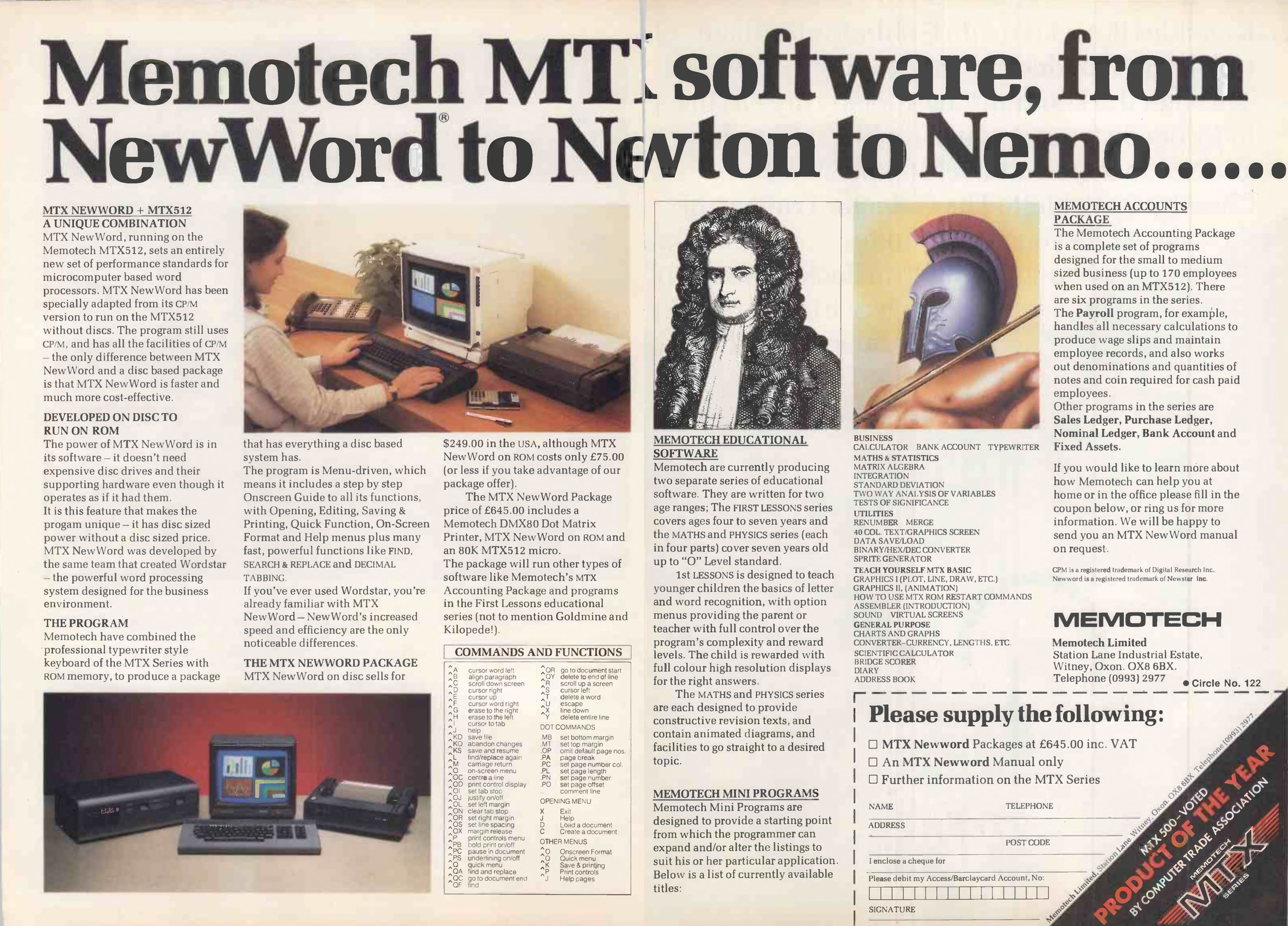
[expand]
Page 1
Memotech MT-
NewWord to Nevton to Nemo......

MTX NEWWORD + MTX512
A UNIQUE COMBINATION
MTX NewWord, running on the
Memotech MTX512, sets an entirely
new set of performance standards for
microcomputer based word
processors. MTX NewWord has been
specially adapted from its CP/M
version to run on the MTX512
without discs. The program still uses
cp/M, and has all the facilities of CP/M
the only difference between MTX
NewWord and a disc based package
is that MTX NewWord is faster and
much more cost-effective

DEVELOPED ON DISC TO
RUN ON ROM
The power of MTX NewWord is in
its software — it doesn’t need
expensive disc drives and their
supporting hardware even though it
operates as if it had them.
It is this feature that makes the
progam unique — it has disc sized
power without a disc sized price.
MTX NewWord was developed by
the same team that created Wordstar
- the powerful word processing
system designed for the business
environment.

THE PROGRAM

Memotech have combined the
professional typewriter style
keyboard of the MTX Series with
ROM memory, to produce a package

that has everything a disc based
system has.

The program is Menu-driven, which
means it includes a step by step
Onscreen Guide to all its functions,
with Opening, Editing, Saving &
Printing, Quick Function, On-Screen
Format and Help menus plus many
fast, powerful functions like FIND,
SEARCH & REPLACE and DECIMAL.
TABBING.

If you’ve ever used Wordstar, you're
already familiar with MTX
NewWord— NewWord’s increased
speed and efficiency are the only
noticeable differences

THE MTX NEWWORD PACKAGE
MTX NewWord on disc sells for

$249.00 in the usa, although MTX
NewWord on ROM costs only £75.00
(or less if you take advantage of our
package offer)

The MTX NewWord Package
price of £645.00 includes a
Memotech DMX80 Dot Matrix
Printer, MTX NewWord on ROM and
an 80K MTX512 micro.

The package will run other types of
software like Memotech’s MTX
Accounting Package and programs
in the First Lessons educational
series (not to mention Goldmine and
Kilopede!)

{| COMMANDS AND FUNCTIONS _

0 10 document start
delete to end of line
scroll up a screen
cursor left

i

Tine down
delete entire ine
DOT COMMANDS

et bottom margin
MT settop margin |
OP omit default page nos.
PA page break

PC Set page number col
BL set pagelenath

204 justly ono
OL set lett margi
‘ON ceara0 stoo
R in

C Create a document
OTHER MENUS
ZO Onscteen Format |
30 Quick meny
29) guckmeny RK Save 8 printing |
A place 3° Print controls
ocument end Help pages

MEMOTECH EDUCATIONAL
SOFTWARE

Memotech are currently producing
two separate series of educational
software. They are written for two
age ranges; The FIRST LESSONS series
covers ages four to seven years and
the MATHS and PHYSICS series (each
in four parts) cover seven years old
up to “O” Level standard.

1st LESSONS is designed to teach
younger children the basics of letter
and word recognition, with option
menus providing the parent or
teacher with full control over the
program’s complexity and reward
levels. The child is rewarded with
full colour high resolution displays
for the right answers.

The MATHS and PHYSICS series
are each designed to provide
constructive revision texts, and
contain animated diagrams, and
facilities to go straight to a desired
topic.

MEMOTECH MINI PROGRAMS
Memotech Mini Programs are
designed to provide a starting point
from which the programmer can
expand and/or alter the listings to

suit his or her particular application.

Below is a list of currently available
titles:

BUSINESS
CALCULATOR BANK ACCOUNT TYPEWRITER
MATHS & STATISTICS

MATRIX ALGEBRA

INTEGRATION

STANDARD DEVIATION

TWO WAY ANALYSIS OF VARIABLES

‘TESTS OF SIGNIFICANCE

UTILITIES

RENUMBER MERGE

40 COL. TEXT/GRAPHICS SCREEN

DATA SAVE/LOAD

BINARY/HEX/DEC CONVERTER

SPRITE GENERATOR

TEACH YOURSELF MTX BASIC

GRAPHICS I (PLOT, LINE, DRAW, ETC.)
GRAPHICS Il, (ANIMATION)

HOW TO USE MTX ROM RESTART COMMANDS.
ASSEMBLER (INTRODUCTION)

SOUND VIRTUAL SCREENS

GENERAL PURPOSE

CHARTS AND GRAPHS,
CONVERTER-CURRENCY, LENGTHS, ETC.
SCIENTIFIC CALCULATOR

BRIDGE SCORER

DIARY

ADDRESS BOOK

NAME

ADDRESS

Tenclose a cheque for

Please supply the following:

0 MTX Newword Packages at £645.00 inc. VAT
O An MTX Newword Manual only
O Further information on the MTX Series

TELEPHONE

POST CODE

software, from

MEMOTECH ACCOUNTS
PACKAGE

The Memotech Accounting Package
is a complete set of programs
designed for the small to medium
sized business (up to 170 employees
when used on an MTX512). There
are six programs in the series.

The Payroll program, for example,
handles all necessary calculations to
produce wage slips and maintain
employee records, and also works
out denominations and quantities of
notes and coin required for cash paid
employees.

Other programs in the series are
Sales Ledger, Purchase Ledger,
Nominal Ledger, Bank Account and
Fixed Assets.

If you would like to learn more about
how Memotech can help you at
home or in the office please fill in the
coupon below, or ring us for more
information. We will be happy to
send you an MTX NewWord manual
on request

CPM isa registered trademark of Digital Research Inc
Newword isa registered trademark of Newstar Ine.

MEMOTECH

Memotech Limited

Station Lane Industrial Estate,

Witney, Oxon. OX8 6BX.

Telephone (0993) 2977 @ Circle No. 122

Please debit my Access/Barclaycard Account, No:

l SEER)

SIGNATURE
[/expand]
‘Newton to Nemo…’
Memotech’s Memotech MTX512 was an 8-bit Z80A based home computer that primarily sold in the UK, France, and Scandinavia. The MTX512’s 4MHz Z80A CPU was paired with 64KB of system RAM and a further 16KB of dedicated video RAM for use with the Texas Instruments TMS9918 onboard graphics chip. Mass storage was provided by interfaces for tape, cartridge, or 5.25” floppy drive and sound was provide by a Texas Instruments SN76489.
The default system software was an MTX-dialect of BASIC, however the MTX512 could also optionally run CP/M 2.2. MTX NewWord was a WordStar-style word processor for the MTX512 when run with the CP/M operating system.
A positive review of the Memotech MTX512 can be found in Creative Computing Magazine Volume 10, Issue 6 (June 1984).